

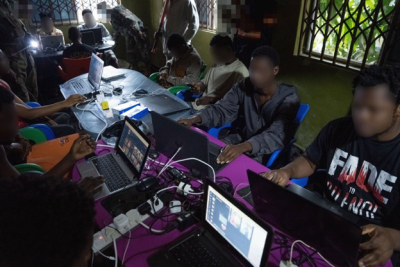
The Sasaabi cybercrime raid has brought renewed attention to the scale of online fraud and the human harm connected to organised scam networks. Ghanaian authorities arrested 19 people in Sasaabi, near Accra, during an international enforcement effort, while investigators identified 89 victims of online scams who reportedly lost an estimated US$8.3 million.
The Ghana News Agency reported on October 14 that officers also seized 303 electronic devices and identified 117 suspected human-trafficking victims awaiting repatriation to Nigeria. The operation formed part of “Joint Disruption Week”, a coordinated effort involving law-enforcement agencies and technology companies working to disrupt criminal networks operating across West Africa.
Photo: Ghana News Agency image associated with the October 2026 scam-centre operation.
What investigators say happened
The Ghana operation was led by the Cyber Security Authority, the Criminal Investigation Department of the Ghana Police Service and the National Security Service, with support from international partners including the United Kingdom’s National Crime Agency, the Federal Bureau of Investigation and Nigeria’s Economic and Financial Crimes Commission.
The wider operation resulted in 28 arrests across Ghana and Nigeria, according to the reported figures. Authorities and technology companies also disrupted more than 3.7 million fraudulent social-media accounts, pages and groups, and identified more than US$11 million in funds that may be frozen. These figures describe a cross-border effort rather than a single police action, so the national and international totals should not be confused.
The 89 scam victims identified in connection with the Ghana operation reportedly suffered losses estimated at US$8.3 million. Authorities also identified 117 suspected trafficking victims. Investigators said scam networks can recruit or coerce people into working in fraud operations, meaning enforcement efforts may involve both alleged offenders and people who may themselves have been exploited.
Why online scam centres can cause widespread damage
Online fraud is not limited to one message or one fake profile. Organised groups may use several accounts, websites, phone numbers and payment channels to contact victims in different countries. Some schemes impersonate police or other officials and threaten arrest unless money is sent. Others use fake investment platforms, including cryptocurrency offers that promise unusually high returns.
One known method, sometimes called “pig butchering”, involves criminals building a relationship with a target over time before persuading the person to transfer money into a fraudulent investment. The relationship may be presented as friendship, romance, mentorship or a business opportunity. Once the victim deposits funds, the platform may show false profits and then block withdrawals or demand additional payments.
Scammers may also use digital extortion, claiming they have compromising information or can arrange legal trouble. The pressure to act quickly is a warning sign. Legitimate authorities do not ordinarily demand payments through private messages, cryptocurrency transfers or gift cards to make an arrest threat disappear.
Practical warning signs for Ghanaians
Consumers should be cautious when a new online contact quickly introduces an investment, asks for secrecy or insists that a payment must be made immediately. Verify the identity of anyone claiming to represent a bank, government agency, police service or investment firm by contacting the organisation through an independently located official channel.
Do not share mobile-money PINs, banking passwords, one-time verification codes or copies of identity documents with strangers. Avoid installing remote-access applications at the request of an unknown caller. Before investing, check whether the provider is authorised by the relevant regulator and be sceptical of guaranteed profits or pressure to recruit friends and relatives.
If money has already been sent, contact the bank, mobile-money provider or cryptocurrency exchange promptly and preserve screenshots, account names, transaction references and messages. Report the incident to the appropriate authorities. Recovery is not guaranteed, but quick reporting can preserve evidence and may help providers respond.
International cooperation remains important
Investigators say the operation involved agencies and technology firms from several countries. That cooperation matters because online scams frequently cross borders: the person communicating with a victim may be in one country, the account hosting a fraudulent profile in another and the payment destination somewhere else.
Technology companies can remove fake accounts and share relevant information under applicable procedures, while investigators can use evidence to identify suspected networks and pursue cases. However, removing accounts is only one part of the response. Public education, financial-sector safeguards, victim support and prosecution of offenders are also important.
What readers should take from the raid
The figures from Sasaabi show why online fraud should be treated as a serious financial and public-safety issue. The reported losses are substantial, but the wider concern includes the people who may have been trafficked, coerced or deceived into participating in criminal activity.
Readers should not assume that every online investment or international contact is fraudulent. Instead, use independent verification, pause when a request feels urgent, and avoid sending money that cannot be afforded to lose. Anyone who suspects they are being manipulated should seek advice from a trusted person or a regulated financial institution before transferring funds.
Sources and further reading
Read the Ghana News Agency’s report on the Sasaabi operation and the United States Department of Justice for related international enforcement information. Ghana Gossips will continue to cover verified local developments and public-safety issues. Visit news.ghanagossips.org for more Ghanaian trending news and community updates, including our coverage of water financing and community services.
Frequently asked questions
How many people were arrested in Sasaabi?
Authorities reported 19 arrests in Ghana during the operation described by the Ghana News Agency.
How much did identified scam victims reportedly lose?
The report says 89 identified victims suffered estimated losses of US$8.3 million.
What should someone do after a suspected scam?
Contact the relevant bank or payment provider immediately, preserve evidence and report the incident through official channels.


















Leave a Reply