

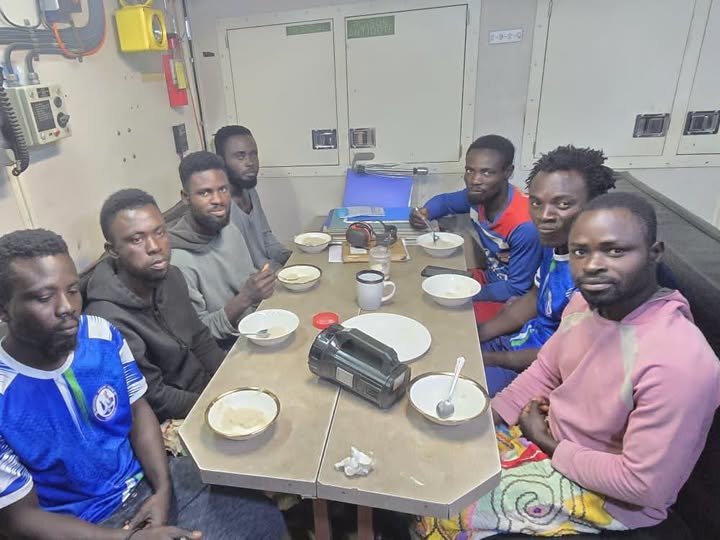
The safe return of seven Ghanaian fishermen to Tema after 12 days adrift in the Gulf of Guinea has brought relief to their families and coastal communities, while raising fresh questions about safety equipment and emergency communication on artisanal fishing canoes. The crew of the canoe Second Chance left Sekondi on October 9 for a fishing expedition towards Axim. An engine failure and strong sea winds left the canoe drifting eastward, eventually into the territorial waters of Benin, where the men were located and rescued through a multinational operation.
The Ghana Maritime Authority, Ghana Navy, Togo Navy, Benin Navy, regional maritime coordination centres and local fishermen all played roles in the operation. The fishermen arrived at Tema Fishing Harbour on October 22. The Ghana National Association of Farmers and Fishermen (GNAFF), in a statement reported by the Ghana News Agency on October 25, commended the participating countries and said the incident underscored the need for stronger safety measures for artisanal fishers operating far from shore.
How the canoe drifted across maritime borders
Accounts from the Ghana Maritime Authority and the Ghana News Agency say the crew departed Sekondi Fishing Harbour on October 9 for a trip towards Axim in the Western Region. The canoe’s outboard motor failed, leaving the men unable to control their direction as winds and currents carried them east. GNAFF said the canoe drifted approximately 120 nautical miles from Axim and crossed into Togolese and Beninese waters. The incident demonstrates how a mechanical problem on a small vessel can quickly become a cross-border emergency.
The reporting timeline contains several separate points that should not be collapsed into a single moment. GNAFF said its Western Regional Steering Committee alerted the association’s national secretariat on October 9, while the canoe owner later reported the fishermen missing to police on October 18 after repeated attempts to contact them failed. The Ghana News Agency reported that the Vessel Traffic Management and Information System unit, working with the Navy, National Signals Bureau, Marine Police and the canoe owner, established contact with the drifting crew on October 21. Other reporting described a distress alert from the Fisheries Commission on October 20. These accounts describe different parts of the response chain; they do not change the central fact that the crew was found alive.
The Benin Navy and a local Beninese fishermen’s association located the crew at about 10:36 p.m. Ghana time on October 21, according to the Information Services Department. The men were handed to the Togolese Navy later that night and transferred to the Ghana Navy off Aflao at about 6:49 a.m. on October 22. The Ghana Navy vessel GNS Aflao brought them and the recovered canoe to Tema Fishing Harbour.
Why the rescue depended on cooperation
The canoe did not remain inside one country’s waters. Once it drifted beyond Ghana’s maritime boundary, finding it required information to move between agencies and neighbouring states. The operation involved Ghanaian maritime and security institutions, the navies of Togo and Benin, regional coordination centres and local fishing communities. The local Beninese fishers’ role is particularly important: people who work at sea may notice a vessel or crew in distress before a formal patrol reaches the area.
The rescue also shows why regional maritime coordination is not merely a diplomatic concept. A distress report, position information, patrol assets and a handover arrangement have to connect in real time. A delay in any link can narrow the window for finding a small canoe. The operation succeeded, but the fact that the men spent nearly two weeks adrift should keep attention on prevention, not only the successful conclusion.
Authorities said the fishermen were in good condition when they were received, and they were provided with food and medical attention. The Information Services Department said the Ghana Maritime Authority was providing accommodation and the Ghana Armed Forces had supplied relief items, including food and life jackets, while the crew underwent screening. Those immediate measures matter, but the longer-term policy question is how to reduce the chance that another canoe becomes untraceable after an engine failure.
The safety gaps identified after the incident
Reporting by Citi Newsroom and Angel Online described challenges involving communication, the absence of distress-signal transponders on the canoe and limited night-vision capability during the search. The Fisheries Commission has been considering distress-tracking devices for small fishing vessels, while GNAFF has called for mandatory safety equipment, GPS and tracking technology, coordinated regional patrols, cross-border intelligence-sharing and clear emergency channels.
A tracking device is useful only if it is affordable, maintained, charged or powered, and connected to an organisation that can respond. A requirement that fishers cannot realistically meet could push operators away from formal systems or leave equipment unused. A workable programme needs consultation with canoe owners, fishers’ associations, regulators and technology providers. It should explain which device is required, who pays, how the signal is monitored, what happens when a device fails and how fishers can request help without fear of punishment for a technical fault.
Safety equipment also needs to match the conditions in which artisanal fishers work. Life jackets, communication equipment, navigation aids and a functioning engine are not interchangeable safeguards. Training and pre-departure checks can help crews identify mechanical problems before leaving shore. Owners and crews should know how to send a distress alert, share their position and keep contact details for the relevant authorities. The exact equipment standard should be set by the competent agencies, not improvised by individual news reports.
What fishers and canoe owners can do
Before a trip, crews should check the engine, fuel, basic tools, weather information and communication equipment. They should tell a trusted person where they are going, the expected return time and the number of people aboard. A simple departure record can make it easier for families and authorities to recognise when a vessel is overdue. Where an approved location device or distress beacon is available, crews should know how to use it and confirm that it is working.
Owners should treat safety spending as part of operating a canoe rather than an optional extra. They can arrange regular engine maintenance, ensure that crews have suitable life jackets, and make sure everyone understands the emergency procedure. Fishers’ associations can help share information about approved equipment and report common barriers, such as cost, charging, coverage or repair access. A device that cannot be maintained locally may offer less protection than its advertised features suggest.
Families and community members can also help by passing on an overdue-vessel report promptly. The owner in this case made repeated attempts to reach the crew before reporting the disappearance, according to the GNA account. Clear local procedures can reduce uncertainty about when to contact police, the Fisheries Commission or the maritime authority. Prompt reporting does not replace a distress signal, but it can start the search sooner.
What government and maritime agencies should clarify
The proposed tracking measures need a public implementation plan. That plan should identify the responsible agency, the rollout schedule, the equipment standard, the financing model and the way signals will be monitored. It should also describe how data will be protected and who can access a canoe’s location information. Fishers need to understand that tracking is meant to improve safety and response, not to create a new fee or expose their routine movements without safeguards.
Authorities should publish lessons from the rescue without disclosing information that would compromise security. Useful details include how the first report was received, when the crew’s location was established, how the regional handovers were coordinated and which communication gaps delayed the response. If timelines differ between agency summaries, a single after-action review could reconcile the sequence and help improve future operations.
Regional coordination should include local communities, not only naval and government offices. Fishing communities have practical knowledge of sea conditions, routes and the places where a drifting canoe might be carried. A reliable reporting network could connect those communities with maritime coordination centres and provide clear ways to share a sighting. The rescue near Grand-Popo illustrates how local knowledge can complement formal patrol capacity.
A successful rescue should lead to prevention
The return of the seven fishermen is a welcome outcome, and GNAFF’s commendation reflects the importance of cooperation among Ghana, Togo, Benin and regional maritime institutions. But a successful rescue is not a substitute for a safer operating environment. Small fishing canoes are economically important to coastal communities, and the people who use them should have practical access to equipment, training and emergency support.
The next steps are concrete: make safety equipment accessible, agree on a realistic tracking standard, improve distress communication, establish prompt reporting procedures and publish a clear account of how the response worked. These measures can reduce the time between an engine failure and a rescue alert. The lesson from Second Chance is not that the sea can be controlled; it is that better preparation and coordination can give crews a stronger chance of being found.
Read more Ghana news through the Ghana Gossips News homepage and its Trending News section.
Sources
- Ghana News Agency: Seven rescued Ghanaian fishers return to Tema
- Information Services Department: Ghana Maritime Authority confirms rescue
- GNA: GNAFF commends Ghana, Togo and Benin
- Angel Online: Fisheries Minister calls for modern safety technology
- Citi Newsroom: Seven missing fishermen arrive safely at Tema
















Leave a Reply